
1. Táirge Tharview
The RODOT 433M Wireless Remote Switch is a high-power relay control system designed for various electrical equipment. It operates on 110V-240V AC and features a 30A relay, supporting up to 3000 watts resistive load and 800 watts inductive load. The system includes a receiver and two remote controls, offering a long-range wireless control distance of up to 100 meters (328 feet) in open environments.

Image: The RODOT 433M Wireless Remote Switch, showing the receiver unit and two accompanying remote controls.
2. Faisnéis Sábháilteachta
Always ensure power is disconnected before installation or maintenance. This device operates with high voltage (110V-240V AC) and high current (up to 30A). Improper installation can lead to electric shock, fire, or equipment damage. If you are unsure about electrical wiring, consult a qualified electrician.
- Do not exceed the maximum load ratings (3000W resistive, 800W inductive).
- Cinntigh go bhfuil gach nasc slán agus inslithe.
- Coinnigh an gléas ar shiúl ó uisce agus ó thaise iomarcach.
- Do not place the receiver or remote in a metal case or near large metal objects, as this can affect signal range.
3. Ábhar Pacáiste
- 1 x RODOT 433M Wireless Remote Switch Receiver
- 2 x Remote Controls (with 2 CR2032 batteries included)
4. Socrú agus Suiteáil
4.1. Sreangú an Ghlacadóra
The receiver unit has clearly labeled terminals for AC Input (L, N) and AC Output (L, N). Ensure correct polarity when connecting to your power source and load.

Image: Close-up of the receiver unit, highlighting the learning button and AC input/output terminals.
Standard Wiring (for loads within 30A / 3000W resistive / 800W inductive):
- Disconnect power to the circuit before wiring.
- Connect the AC Live (L) wire from your power source to the 'AC Input L' terminal on the receiver.
- Connect the AC Neutral (N) wire from your power source to the 'AC Input N' terminal on the receiver.
- Connect the Live (L) wire of your electrical load (e.g., light, pump) to the 'AC Output L' terminal on the receiver.
- Connect the Neutral (N) wire of your electrical load to the 'AC Output N' terminal on the receiver.
- Cinntigh go bhfuil gach nasc daingean agus slán.

Image: Simplified wiring diagram showing the connection of the remote switch to a 110V-240V AC power source and a light bulb load.
4.2. Wiring for High-Power Inductive Loads (above 800W) using an AC Contactor
For frequent use with high-power inductive loads like water pumps or motors exceeding 800W, it is recommended to use an external AC contactor (not included) to protect the relay within the switch. The remote switch will then control the contactor, which in turn controls the high-power load.
- Connect the remote control switch's AC Input L and N to your 220V power source.
- Connect the remote control switch's AC Output L and N to the A1 and A2 terminals of your AC contactor.
- Connect the L2 and L3 terminals of the AC contactor to your 220V power source.
- Connect your high-power motor or pump to the output terminals of the AC contactor.

Image: Detailed wiring schematic illustrating how to connect the remote switch to an AC contactor for controlling high-power motors.
5. Treoracha Oibriúcháin
5.1. Learning Remote Controls (Pairing)
The receiver can learn up to 20 remote controls. Each button (ON/OFF) on a remote can be learned independently.
- Press the learning button on the receiver once. The indicator light will turn on.
- Press the desired button (ON or OFF) on the remote control. The indicator light on the receiver will flash three times, indicating successful pairing.
- Repeat for other buttons or additional remote controls.
5.2. Clearing Paired Remotes
To clear all paired remote controls from the receiver's memory:
- Press and hold the learning button on the receiver for approximately 8 seconds until the indicator light flashes 8 times. All previously paired remotes will be deleted.
5.3. Setting Working Modes
The receiver supports three working modes: Instantaneous (Inching), Self-locking, and Interlocking. The mode is set by pressing the learning button a specific number of times.
Mode 1: Instantaneous (Inching) Mode
- Cur síos: The relay is activated only while the remote button is pressed. Releasing the button deactivates the relay.
- Socrú: Press the learning button on the receiver uair amháin. The indicator light will turn on. Then, press the desired remote button (e.g., ON). The indicator light will flash three times.
Mode 2: Self-locking Mode
- Cur síos: Pressing the remote button activates the relay, and it remains active until the same button is pressed again to deactivate it.
- Socrú: Press the learning button on the receiver faoi dhó. The indicator light will turn on. Then, press the desired remote button (e.g., ON). The indicator light will flash three times.
Mode 3: Interlocking Mode
- Cur síos: This mode requires two buttons on the remote. Pressing one button activates the relay, and it remains active. Pressing the second button deactivates the first relay and activates a second (if applicable), or simply deactivates the first. (Typically used with ON/OFF pairs where ON activates and OFF deactivates).
- Socrú: Press the learning button on the receiver trí huaire. The indicator light will turn on. Then, press the 'ON' button on the remote, followed by the 'OFF' button on the same remote. The indicator light will flash three times after each button press.
5.4. Power-on State Setting
By default, the receiver is in an OFF state when power is applied. To change this:
- Press the learning button on the receiver sé huaire.
- The indicator light will flash three times, confirming the setting is successful. The receiver will now power on in the ON state.
6. Cothabháil
6.1. Athsholáthar Ceallraí Rialaithe Cianrialtáin
The remote controls use CR2032 batteries. If the remote control distance decreases significantly or the remote stops responding, replace the battery.
- Oscail an cianrialtán go cúramach casing.
- Bain an ceallraí CR2032 d'aois.
- Cuir isteach ceallraí CR2032 nua, ag cinntiú polaraíocht cheart.
- Close the remote control casing.

Image: Two remote controls, each with ON and OFF buttons, used to operate the wireless switch.
6.2. Signal Optimization
The remote control distance can be affected by environmental factors. To optimize signal range:
- Ensure the receiver and remote control antennas are straightened.
- Avoid placing the receiver or remote inside metal enclosures or near large metal objects.
- Replace the remote control battery if the range is consistently poor.
7. Fabhtcheartú
7.1. Issue: Device does not stay ON after pressing the remote button.
Cúis Féideartha: The receiver is set to Instantaneous (Inching) mode.
Réiteach: Re-program the receiver to Self-locking mode (press learning button twice, then remote button) or Interlocking mode (press learning button three times, then ON/OFF buttons) as desired. Refer to the "Setting Working Modes" section.
7.2. Issue: Remote control does not pair with the receiver.
Cúiseanna Féideartha:
- Nós imeachta péireála mícheart.
- Tá ceallraí an rialaitheora cianda íseal nó marbh.
- Receiver memory is full (max 20 remotes).
Réitigh:
- Review the "Learning Remote Controls" section and repeat the steps carefully.
- Cuir an ceallraí cianrialaithe in ionad.
- Clear all paired remotes from the receiver's memory (press learning button 8 times) and then attempt to pair again.
7.3. Issue: Remote control range is poor.
Cúiseanna Féideartha:
- Low remote control battery.
- Obstructions (walls, metal objects) between the remote and receiver.
- Antennas are not optimally positioned.
Réitigh:
- Cuir an ceallraí cianrialaithe in ionad.
- Ensure the receiver and remote antennas are straightened.
- Relocate the receiver or remote to an area with fewer obstructions.
8. Sonraíochtaí
| Gné | Sonraíocht |
|---|---|
| Branda | RODOT |
| Múnla | 110V-240V Remote Switch |
| Vol Oibriúcháintage | 110V-240V AC |
| Rátáil Reatha | 30 Amps |
| Max Resistive Load | 3000 Watts |
| Max Inductive Load | 800 Watts |
| Minicíocht Gan Sreang | 433M |
| Raon Cianrialú | Suas le 100 méadar (328 troigh) i limistéir oscailte |
| Modhanna Oibre | Instantaneous (Inching), Self-locking, Interlocking |
| Toisí an Ghlacadóra | 3.54 x 2.76 x 1.18 orlach |
| Meáchan Mír | 5.3 unsa |
| Cadhnraí cianda | 2 x CR2032 (san áireamh) |

Image: Visual representation of product features including high power support, PC material shell, signal antenna, compact size, and long remote control distance.
9. Iarratas Examples
This wireless remote switch is suitable for a wide range of applications, including:
- Controlling pumps (e.g., water pumps, irrigation systems)
- Lighting control (e.g., ceiling lights, chandeliers)
- Industrial control (e.g., production workshops, motors)
- Home appliances (e.g., fans, dust collectors)
- Córais slándála
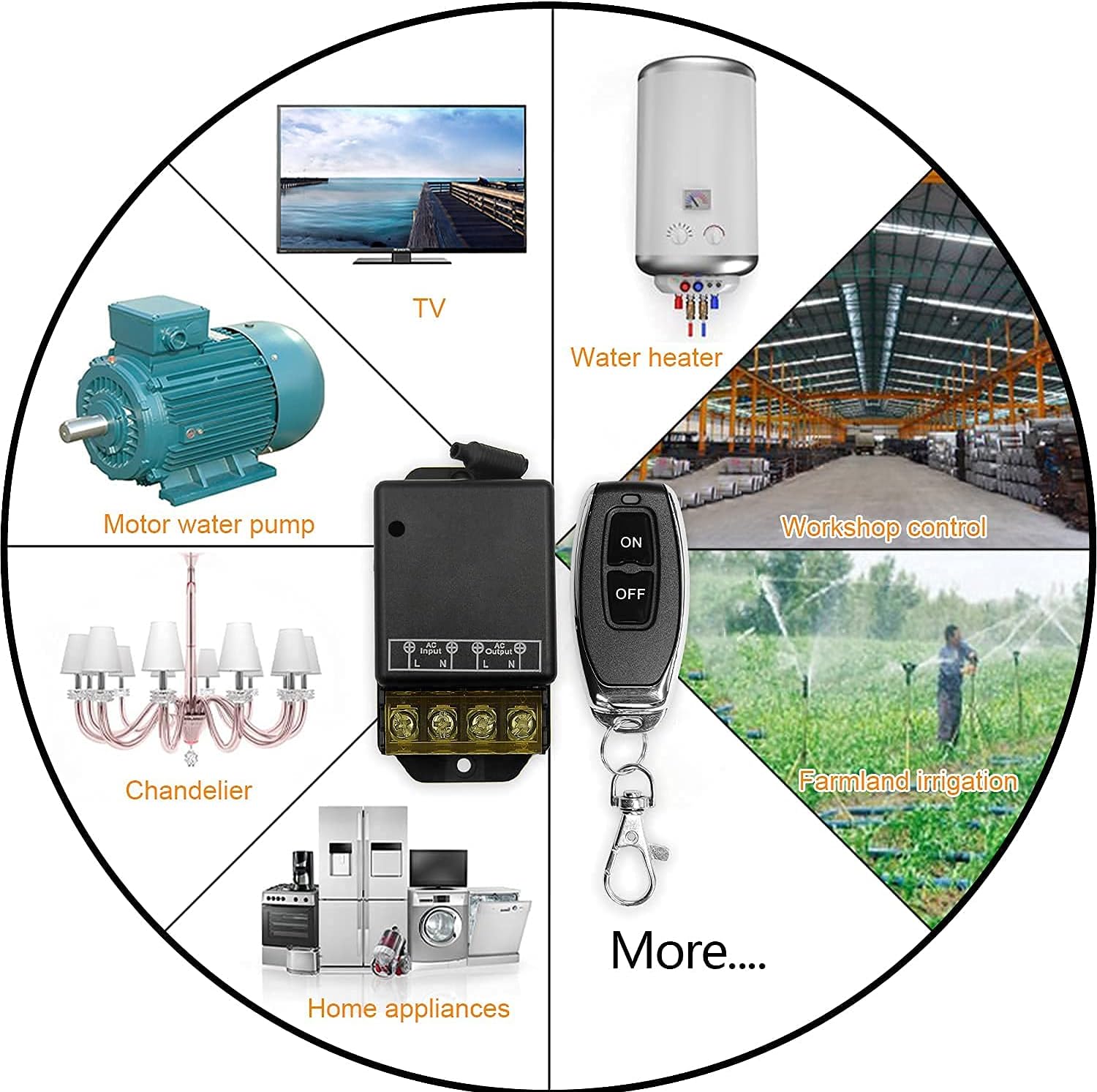
Íomhá: Examples of common applications for the wireless remote switch, such as controlling motors, water heaters, and various lighting fixtures.
10. Barántas agus Tacaíocht
Specific warranty details are not provided in this manual. For warranty information, technical support, or further assistance, please contact RODOT customer service through your purchase platform or the official RODOT websuíomh.